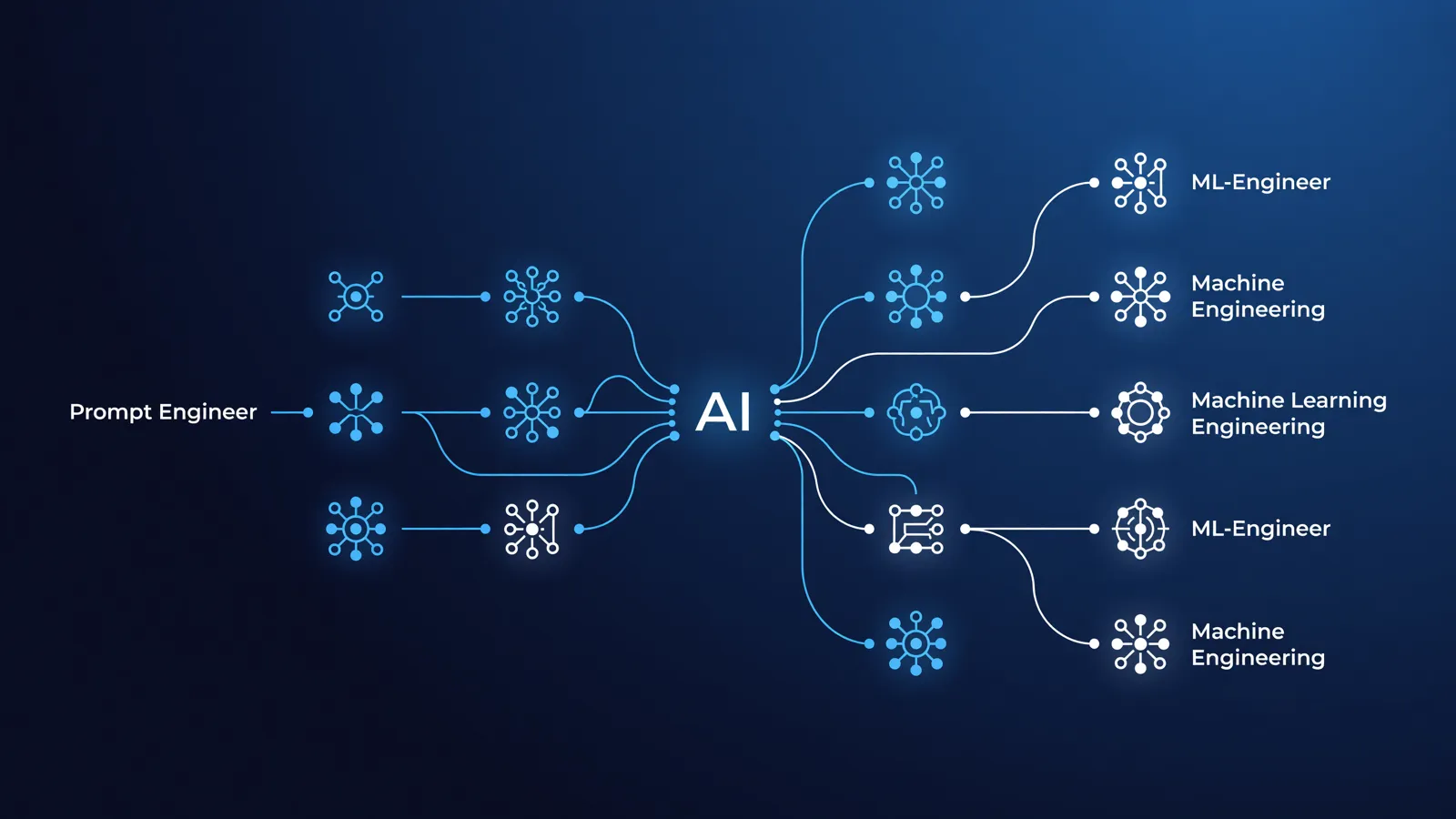
AI Roles Explained: From Prompt Engineer to ML Engineer
The rapid rise of generative AI and language models has transformed the job market. While traditional IT roles are evolving, completely new specializations are also emerging. This guide provides an overview of the key AI roles, the required skills, and the field of work in which these professionals operate.
Prompt Engineer
The Prompt Engineer is the bridge between human intent and artificial intelligence. This role revolves around designing, refining, and systematically testing input (prompts) to ensure optimal and accurate output from a Large Language Model (LLM).
- Tasks: Writing and iterating complex prompts, securing against prompt injections, and tailoring output to specific use cases.
- Required skills: Analytical thinking, strong language skills, basic programming knowledge (such as Python), and an understanding of LLM architecture.
- Field of work: Often active within marketing agencies, customer service automation, and AI-driven startups Indication.
Machine Learning (ML) Engineer
An ML Engineer designs and builds the foundational systems that enable algorithms to learn from data. While a Data Scientist proves the theory and mathematics, the ML Engineer brings the models into production environments.
- Tasks: Developing scalable machine learning pipelines, optimizing inference speeds, and deploying models in the cloud.
- Required skills: Advanced programming skills (Python, C++), a strong mathematical foundation, and in-depth experience with frameworks like PyTorch or TensorFlow. Knowledge of MLOps is crucial.
- Field of work: Large tech companies, financial institutions, and specialized AI laboratories Indication.
AI Solutions Architect
The AI Solutions Architect is the strategist of AI implementation. This professional designs the broader technical infrastructure and ensures that new AI solutions integrate securely and seamlessly with existing business processes and networks.
- Tasks: Translating business goals into technical cloud architecture, selecting the right closed- or open-source models, and setting up RAG (Retrieval-Augmented Generation) architectures.
- Required skills: Broad knowledge of cloud platforms (AWS, Azure), software architecture, API integrations, and vector databases (such as Pinecone or Weaviate).
- Field of work: Consultancy firms, enterprise IT departments, and SaaS platforms Indication.
AI Ethics & Compliance Officer
As AI gains more decision-making authority, the demand for responsible deployment grows. This relatively new role monitors the ethical and legal boundaries of data and AI applications within an organization.
- Tasks: Auditing models for bias, ensuring strict compliance with regulations (such as the EU AI Act), and establishing guidelines for responsible data use.
- Required skills: Background in IT law or ethics, combined with a solid understanding of how algorithms and black-box models function (Explainable AI).
- Field of work: Government agencies, legal advisory firms, and large corporate organizations Indication.
Building Skills?
The transition to a career in artificial intelligence begins with the right knowledge. Do you want to retrain, learn the latest frameworks, or sharpen your current IT skills? Visit our learning materials and guides at leren.llmnet.nl.