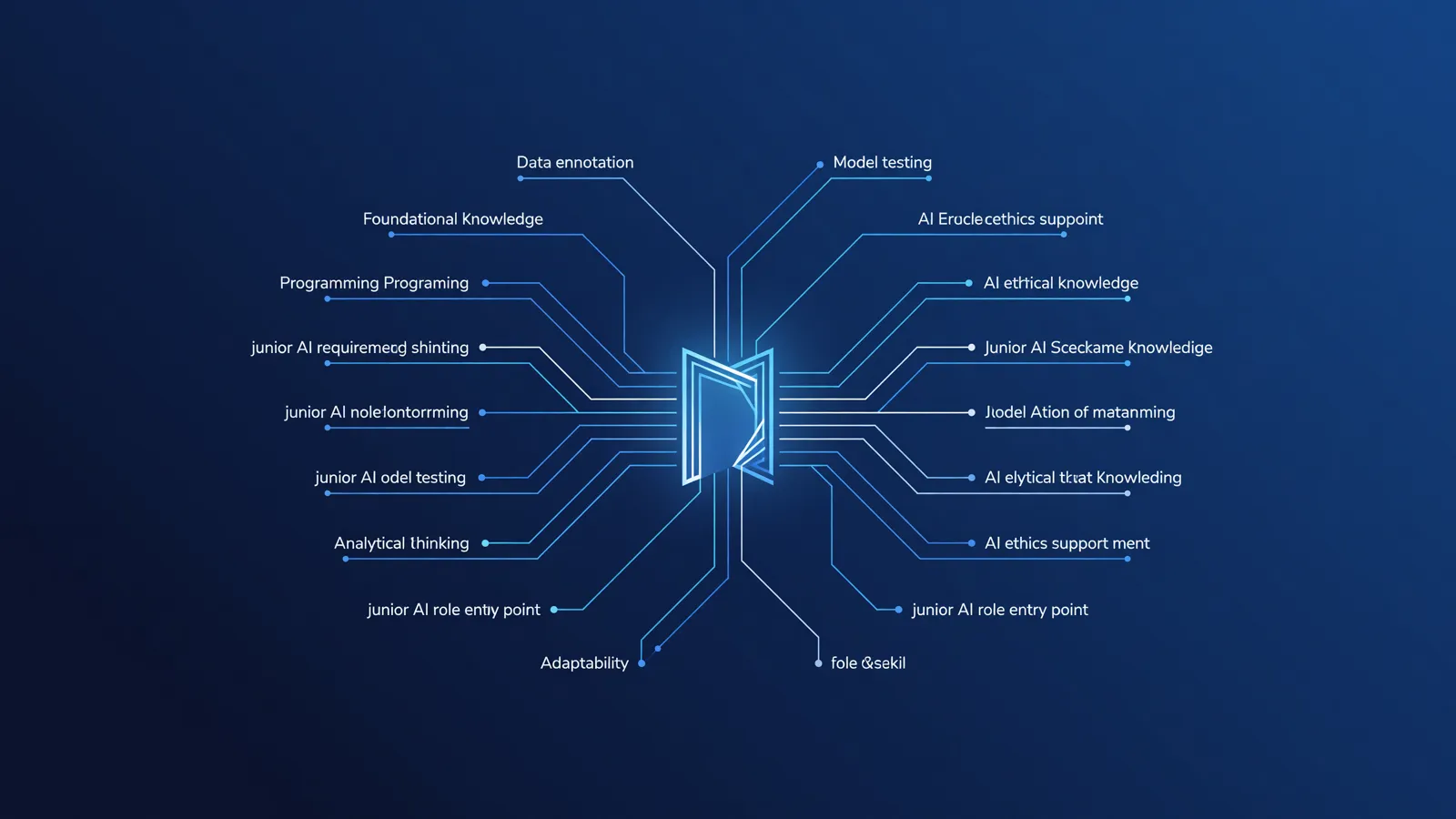
Entering an AI role as a junior: which roles are realistic and what is required?
The rise of generative AI and large language models (LLMs) has accelerated the job market. Companies in almost all sectors are looking for ways to integrate artificial intelligence into their processes. Yet, many starters can no longer see the forest for the trees. Job openings often require years of experience with complex machine learning infrastructure, while the field of LLMs itself is still relatively young. How do you break in as a junior?
In this article, we dissect the AI job market for starters. We look at the job titles that are actually accessible to juniors, the hard and soft skills that employers demand in practice, and how you can optimally present your profile to land that coveted first AI role.
The reality of the AI job market for starters
A common pitfall for starters is applying for heavy "AI Engineer" or "Senior Machine Learning Architect" roles. Many organizations posting these vacancies build foundational models themselves or work with business-critical data infrastructures on a massive scale. Here, there is a steep learning curve, and seniority is required to prevent costly mistakes.
However, the greatest job growth is currently in the application of AI. Companies do not need to train their own base models; they want to use existing models (such as those from OpenAI, Anthropic, or open-source variants) smartly to work more efficiently. This creates an entirely new segment of entry-level roles where agility, learning ability, and domain knowledge are at least as important as deep mathematical knowledge.
Which AI roles are realistic for a junior?
1. AI Implementation Specialist / AI Consultant (Junior)
This is currently one of the most accessible roles for starters, especially for candidates with a business administration or process-oriented background. In this role, you focus on bridging the gap between technology and the workplace. You help departments automate repetitive tasks using AI tools, train colleagues in using LLM interfaces, and build simple automated workflows (for example, via platforms like Zapier or Make in combination with AI APIs).
Employers are not looking for hardcore programmers here, but bridge builders who understand how a business process works and can optimize it with available off-the-shelf AI solutions.
2. Data Analyst with AI focus
The role of Data Analyst has existed for decades, but is transforming rapidly. As a junior in this position, you use AI tools (such as Advanced Data Analysis or specific Python libraries) to clean and visualize large datasets faster. At the same time, you often prepare the data needed to fine-tune models via Retrieval-Augmented Generation (RAG). You write SQL queries, create dashboards, and use language models to translate insights to the business faster.
3. Junior Prompt Engineer / AI Workflow Developer
Although "Prompt Engineer" as a standalone title is often a subject of discussion, optimizing interaction with models is a very real task. As a junior in this area, you are responsible for designing, testing, and refining the prompts that form the backbone of internal chatbots or content generation systems. You understand how context windows work, how to minimize hallucinations in the model, and how to enforce structured output (such as JSON).
4. Junior Data Scientist / ML Engineer
This is the more traditional, technical route. You need a solid background in computer science, mathematics, or statistics. As a junior, you work in a team led by seniors. Your tasks include preparing training data, setting up experiments in scikit-learn or PyTorch, and evaluating the performance of different models. The emphasis is on the mathematical and programming-technical side of artificial intelligence.
What do employers demand from a junior AI professional?
The requirements differ per role, but there is a clear common denominator in what companies expect from starters. It is about a balance between basic technical skills and strong problem-solving abilities.
Hard Skills
- Python: This is undisputed as the lingua franca of AI. A junior must be able to read, modify, and write scripts. Knowledge of libraries like Pandas is a big plus.
- API Integrations: Understanding how to call a REST API is crucial. You need to know how to send a request to an AI model and process the response.
- Database Technologies (SQL and Vector Databases): Data is the fuel for AI. Knowledge of standard relational databases (SQL) is fundamental. Additionally, understanding vector databases is increasingly requested, as they form the basis for RAG applications.
- Basic Understanding of Cloud Platforms: You don't need to be a certified cloud architect, but knowing how to keep a script running in Azure, AWS or Google Cloud Platform helps enormously.
Soft Skills
- Communication: You must be able to explain technical concepts (such as why a model gave an incorrect answer) to non-technical colleagues or management.
- Critical Thinking: AI models are fallible. A good junior never blindly accepts the output of a model, but rigorously verifies facts and logic.
- Adaptability: Tools and best practices in AI change monthly. What you learned last year may now be outdated. Therefore, the ability to learn is more important than ready knowledge.
Overview: Skills per AI role
The table below provides insight into the priority of skills per entry-level role, to help you focus on the right competencies during your development.
| Role | Programming (Python) | Mathematics / Statistics | Business & Processes | Prompting & APIs |
|---|---|---|---|---|
| AI Implementation Specialist | Basic | Low | Very High | High |
| Data Analyst (AI focus) | Intermediate (incl. SQL) | Intermediate | High | Intermediate |
| Junior Prompt Engineer | Basic to Intermediate | Low | Intermediate | Very High |
| Junior ML Engineer | Very High | High | Basic | Intermediate |
How do you increase your chances as a starter?
A degree is often just the starting point. In the fast-paced world of AI, employers look closely at demonstrable, practical experience. Fortunately, the barrier to gaining experience yourself is lower than ever.
Build a portfolio. Make sure you have a public GitHub profile where you showcase small, completed projects. For example, create a simple web application (using Streamlit or Gradio) that summarizes a document or classifies data via an API. Showing working code convinces faster than a CV full of buzzwords.
Focus on a domain. AI is a tool. If you combine AI with specific domain knowledge—such as logistics, HR, or finance—you immediately become more attractive. An employer is often not just looking for an AI expert, but someone who understands how AI can improve their specific business process.
Know the limitations. During job interviews, you will often be tested on whether you know the risks of AI. If you can talk about privacy aspects, data security, and preventing bias in models, you show that you look beyond just the technology. You can find more about the application process and frequently asked questions in our section job application tips for AI roles.
Salary expectations and employment conditions
What can you expect as a junior in terms of compensation? As a rule of thumb (this is a rough estimate, not an exact measurement), starting salaries for technical AI roles in the Netherlands are often slightly above the average for regular IT entry-level positions. This is due to the scarcity of personnel who can bridge the gap between new AI developments and business implementation. In addition to salary, many employers in this sector offer a generous budget for certifications and hardware, as the computing power and knowledge required for AI development evolve rapidly.
Conclusion
Taking the step into an AI role as a junior is absolutely realistic, provided you focus on the right positions and understand what companies really need. The focus is shifting from fundamental research to practical, business implementation. By becoming proficient in basic programming, API usage, and understanding business processes, you make yourself an indispensable link in the modern, AI-driven organization. Take a look at our current job openings to see which junior roles are currently open in the llmnet.nl network.